Search This Blog

Friday, February 26, 2016

Day 106 - Friday

U.S. History I - Periods 2, 5, and 6: 
Essential Question:
-How did the Market Revolution of the 19th Century radically shift commerce (trade) and a way of life for millions of Americans?
-How revolutionary was the Market Revolution in the early 19th Century in American History?
-Why was Industrialization so complex and yet dynamic?

Themes:  Market Revolution, Industrialization, Cotton Gin, Transportation Revolution, Immigration, Population shifts

1. American Politics 2016
-Who's STILL IN and who is now OUT?
-The Polls - RealClearPolitics - Polls - Ughhhh so predictable?!
-Your guide to the 2016 presidential candidates - The Washington Examiner

2. Industrialization Resources will be utilized to facilitate conversations and note-taking for a Jigsaw Activity - Please use the Essential Question above to guide your research and to provide you a direction of creating a major argument regarding your topic. 

A. Population and Immigration
Immigration Percentage Charts
-Foreign Born Immigrants per state 2000
-Where were Immigrants coming from? Pie Charts
-Basic Immigration in American in the 1700-1850's Slideshow
-Immigration in America 1830-1860
-German and Irish Immigrant Chart in USA
-Chart #2 - Germans and Irish vs the rest of Immigrants
-A fascinating study of Population Density (Look at 1700 vs. 1950) What maps are most important and why?  What patterns do you see? What argument can these data charts provide us?
-Population Chart #2
-Population Growth in the Future? Wow...just take a look at the first few pages of this study.  What are your reactions to this United Nations study and projections?

B. Agricultural Revolution
Cotton Production 1820 versus 1860
American Immigrants and Agricultural Life - Database
The Agricultural Revolution Article VS. The New Agricultural Revolution - What is it? How does Agriculture impact societies? What is the major argument that EACH of these articles/essays present?
Growing a Nation: The Story of American Agriculture
Crops and Livestock: The Story of American Agriculture
Farmers and the Land: The Story of American Agriculture

C. Transportation expansion
Map of USA expanding infrastructure - Roads and Canals
Maps of American Railroads expansion from East Coast to the West
Development of Railroads from 1830-1990's
Transportation Revolution
National Road video 

D. Industrial/Product expansion
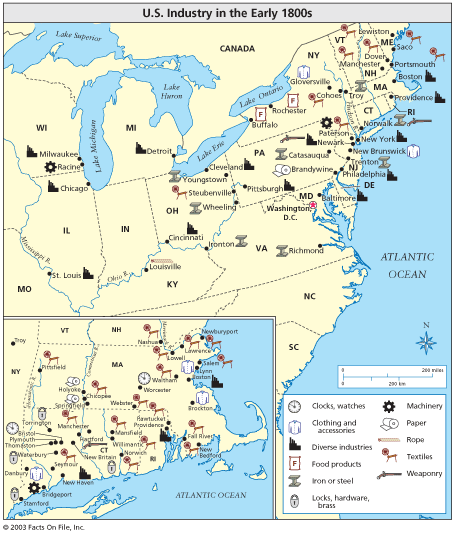
US Industry Map in Early 1800's
Francis Cabot Lowell Video - What was most significant about the Lowell Cotton Mills in New England?
Textile Industrial History
Inventions in the early 1800's
More inventions from 1800-1850's
The Economic Revolution - covers a ton of topics
"The Market Revolution"

Homework:
1. HONOR'S ONLY - Please read the directions, essential question, and documents D-F tonight for homework in the Lowell Girls DBQ.  This essay will be started on Monday and completed in class on Tuesday.

2. HONOR'S ONLY - On Tuesday you will have a multiple choice (50% & Essay 50% TEST) on the Market Revolution, America's First Industrial Revolution, Immigration, and the era of Urbanization from 1800-1850.

3. College Prep - Period 6 - Organize your binders for Monday. I am going to check them all on Monday. 
___________________________________________________

U.S. HISTORY II - Period 1:
Essential Questions:
-How did the United States respond to the attack at Pearl Harbor?
 How does volunteerism demonstrate civic responsibility?
-How did America utilize it's home-front during World War II?
-How important was the home-front to the United States's victory in World War II? 
-How did World War II serve as catalyst for social change in America?

Themes:  Pearl Harbor Attack reaction, The American Homefront, Citizen Soldiers, Social Change, Top-Down Control

1. Your Mini-Presentation Project Presentations will continue today in class.  Each student should be filling out the other group's topics on the Citizen Soldiers Contribution Sheet.

2. WAR PRODUCTION, COMMUNICATION, CONTRIBUTIONS, CIVIL RIGHTS are the major themes. Each of you must be ready to present your case to the class on Thursday.  As each group presents their area of expertise, while the students in the audience will be actively filling out their Citizen Soldiers Contribution Sheet.  You should have created a multimedia presentation on your topic with your group mates and today you will present it in class.

3. Group Categories:

I. Contributions and conservation
-Focus on Large corporations, volunteer groups, etc (NOT on Women!!)

II. Communication
-How did the US government communicate the message of volunteerism and selling the war to America?

III. Women
-What did women do to contribute to the war effort, both at home and abroad?

IV. African Americans, Mexican-Americans, Japanese-Americans, AND any other minority groups
-What did African Americans and other minority groups do to contribute to the war effort? What was their experience like during the war, both at home and abroad?

4. World War II Homefront Resources:
American Troops in World War II
The Smithsonian - Home front Propaganda 
Home front Documents - Photographs and Various Documents
A series of short video clips on various topics involving Women, Food, Investments, and other subject. Look at the title of the "Playlist" and click on the video that would apply to your subject.


World War II Photography Gallery from Time Magazine:
U.S. Home-front During World War II
The National WWII museum - lots of images, primary sources, outline of WWII, and WWII by the numbers!
Library of Congress - World War II Primary Sources
American Women in World War II
America's WWII in Color - PBS special

Homework:
1. Please post your Citizen Soldiers Contribution Sheet to google classroom by 11:59 PM tonight (Friday). SO IF YOU DID NOT DO THIS, THEN PLEASE COMPLETE it for homework tonight. 
_____________________________________________________

International Studies - Period 7
Essential Questions:
1. Does NATO have a new role in the order of international relations in Europe and the World in the    21st Century?
2. Was NATO just or unjust in participating and executing their mission in your post-Cold War scenario?
3. Is the world safer today with the United Nations than it was in 1945?
4. Is the United Nations an effective peace-keeping organization?
5. What should be done to improve the effectiveness of the United Nations?

Themes:  United Nations, Peacekeeping, Universal Declaration of Human Rights, Globalization

1. Peacekeeping Missions - Let's examine where and why peacekeeping missions are currently happening?
-UN Peacekeeping Operations
-Check out the data/facts on current Peacekeeping Missions (please look at the tabs on the right hand side as well that share Troops, Fatalities, Gender, Reports, and the actual data-maps on the right hand side of this website.)


2. Peacekeeping Resources:
-United Nations Peacekeeping Missions
-University of California organized a UN resources guide - Honestly, the BEST and most ORGANIZED I have seen yet on how to research issues concerning the United Nations.
-An impressive viewing of MANY UN Peacekeeping videos - Nearly 5 hours worth of short clips from many Peacekeeping Operations.

3. What is NATO will continue? U.S. State Dept - What is NATO?
The Washington Treaty (aka The North Atlantic Treaty)
What is NATO's mission? Which decisions does it make and why would it be consulted?
-Current NATO missions
-Topics and more on Current NATO missions
-NATO GLOBE MAP


Homework:
1. If you have not download the NATO or Peacekeeping Mission Project please do so.
-PLEASE PICK A NATO MISSION OR A CURRENT UN PEACEKEEPING MISSION and signup here on the Google Document.

2. Please begin your research on your recent NATO/Peacekeeper mission (1992 to present day). You need to pick separate missions, so please fill out the signup sheet here on the Google Document.

3. You MUST create a Google Folder with your topic and last name on it. 
-You must have a basic outline in your Google Folder & Below are items to include on your outline:
-Who is involved in your Google Folder?
-How long have they been there?
-Why Peacekeepers or NATO troops are there?
-Where and what did the situation look like that caused peacekeepers or NATO troops to be engaged in the situation?
-What does the current situation look like? In other words, how effective was the Peacekeeper or NATO situation?
-What challenges did/do Peacekeepers or NATO troops face?

Thursday, February 25, 2016

Day 105 - Thursday

U.S. History I - Periods 2, 5, and 6: 
Essential Question:
-How did the Market Revolution of the 19th Century radically shift commerce (trade) and a way of life for millions of Americans?
-How revolutionary was the Market Revolution in the early 19th Century in American History?
-Why was Industrialization so complex and yet dynamic?

Themes:  Market Revolution, Industrialization, Cotton Gin, Transportation Revolution, Immigration, Population shifts

1. American Politics 2016
-Who's STILL IN and who is now OUT?
-The Polls - RealClearPolitics - Polls - Ughhhh so predictable?!
-Your guide to the 2016 presidential candidates - The Washington Examiner

2. Industrialization Resources will be used to create a Jigsaw Activity - Please use the Essential Question above to guide your research and to provide you a direction of creating a major argument regarding your topic. 

A. Population and Immigration
Immigration Percentage Charts
-Foreign Born Immigrants per state 2000
-Where were Immigrants coming from? Pie Charts
-Basic Immigration in American in the 1700-1850's Slideshow
-Immigration in America 1830-1860
-German and Irish Immigrant Chart in USA
-Chart #2 - Germans and Irish vs the rest of Immigrants
-A fascinating study of Population Density (Look at 1700 vs. 1950) What maps are most important and why?  What patterns do you see? What argument can these data charts provide us?
-Population Chart #2
-Population Growth in the Future? Wow...just take a look at the first few pages of this study.  What are your reactions to this United Nations study and projections?

B. Agricultural Revolution
Cotton Production 1820 versus 1860
American Immigrants and Agricultural Life - Database
The Agricultural Revolution Article VS. The New Agricultural Revolution - What is it? How does Agriculture impact societies? What is the major argument that EACH of these articles/essays present?
Growing a Nation: The Story of American Agriculture
Crops and Livestock: The Story of American Agriculture
Farmers and the Land: The Story of American Agriculture

C. Transportation expansion
Map of USA expanding infrastructure - Roads and Canals
Maps of American Railroads expansion from East Coast to the West
Development of Railroads from 1830-1990's
Transportation Revolution
National Road video 

D. Industrial/Product expansion
US Industry Map in Early 1800's
Francis Cabot Lowell Video - What was most significant about the Lowell Cotton Mills in New England?
Textile Industrial History
Inventions in the early 1800's
More inventions from 1800-1850's
The Economic Revolution - covers a ton of topics
"The Market Revolution"

Homework:
1. CP - Period 6 ONLY - Please answer ONE of the three essential questions above based off our group work today and post it on Google Classroom.

2. HONOR'S ONLY - Please read the directions, essential question, and documents A-C tonight for homework in the Lowell Girls DBQ.  This essay will be started on Monday and completed in class on Tuesday.

3. HONOR'S ONLY - On Tuesday you will have a multiple choice (50% & Essay 50% TEST) on the Market Revolution, America's First Industrial Revolution, Immigration, and the era of Urbanization from 1800-1850. 
___________________________________________________

U.S. HISTORY II - Period 1:
Essential Questions:
-How did the United States respond to the attack at Pearl Harbor?
 How does volunteerism demonstrate civic responsibility?
-How did America utilize it's home-front during World War II?
-How important was the home-front to the United States's victory in World War II? 
-How did World War II serve as catalyst for social change in America?

Themes:  Pearl Harbor Attack reaction, The American Homefront, Citizen Soldiers, Social Change, Top-Down Control

1. You Mini-Presentation Project Presentations will begin today in class.  Each student should be filling out the other group's topics on the Citizen Soldiers Contribution Sheet.

2. WAR PRODUCTION, COMMUNICATION, CONTRIBUTIONS, CIVIL RIGHTS are the major themes. Each of you must be ready to present your case to the class on Thursday.  As each group presents their area of expertise, while the students in the audience will be actively filling out their Citizen Soldiers Contribution Sheet.  You should have created a multimedia presentation on your topic with your group mates and today you will present it in class.

3. Group Categories:

I. Contributions and conservation
-Focus on Large corporations, volunteer groups, etc (NOT on Women!!)

II. Communication
-How did the US government communicate the message of volunteerism and selling the war to America?

III. Women
-What did women do to contribute to the war effort, both at home and abroad?

IV. African Americans, Mexican-Americans, Japanese-Americans, AND any other minority groups
-What did African Americans and other minority groups do to contribute to the war effort? What was their experience like during the war, both at home and abroad?

4. World War II Homefront Resources:
American Troops in World War II
The Smithsonian - Home front Propaganda 
Home front Documents - Photographs and Various Documents
A series of short video clips on various topics involving Women, Food, Investments, and other subject. Look at the title of the "Playlist" and click on the video that would apply to your subject.


World War II Photography Gallery from Time Magazine:
U.S. Home-front During World War II
The National WWII museum - lots of images, primary sources, outline of WWII, and WWII by the numbers!
Library of Congress - World War II Primary Sources
American Women in World War II
America's WWII in Color - PBS special

Homework:
1. As each group presents, students will be filling out their Citizen Soldiers Contribution Sheet SO IF YOU DID NOT DO THIS, THEN PLEASE COMPLETE it for homework tonight. 
_____________________________________________________

International Studies - Period 7
Essential Questions:
1. Does NATO have a new role in the order of international relations in Europe and the World in the    21st Century?
2. Was NATO just or unjust in participating and executing their mission in your post-Cold War scenario?
3. Is the world safer today with the United Nations than it was in 1945?
4. Is the United Nations an effective peace-keeping organization?
5. What should be done to improve the effectiveness of the United Nations?

Themes:  United Nations, Peacekeeping, Universal Declaration of Human Rights, Globalization

1. We are going to explore some of the Peacekeeping Missions - Let's examine where and why peacekeeping missions are currently happening?
-UN Peacekeeping Operations
-Check out the data/facts on current Peacekeeping Missions (please look at the tabs on the right hand side as well that share Troops, Fatalities, Gender, Reports, and the actual data-maps on the right hand side of this website.)


2. Peacekeeping Resources:
-United Nations Peacekeeping Missions
-University of California organized a UN resources guide - Honestly, the BEST and most ORGANIZED I have seen yet on how to research issues concerning the United Nations.
-An impressive viewing of MANY UN Peacekeeping videos - Nearly 5 hours worth of short clips from many Peacekeeping Operations.

3. What is NATO will continue? U.S. State Dept - What is NATO?
The Washington Treaty (aka The North Atlantic Treaty)
What is NATO's mission? Which decisions does it make and why would it be consulted?
-Current NATO missions
-Topics and more on Current NATO missions
-NATO GLOBE MAP


Homework:
1. If you have not download the NATO or Peacekeeping Mission Project please do so.
-PLEASE PICK A NATO MISSION OR A CURRENT UN PEACEKEEPING MISSION and signup here on the Google Document.

2. Please begin your research on your recent NATO/Peacekeeper mission (1992 to present day). You need to pick separate missions, so please fill out the signup sheet here on the Google Document.

3. You MUST create a Google Folder with your topic and last name on it. 
-You must have a basic outline in your Google Folder & Below are items to include on your outline:
-Who is involved in your Google Folder?
-How long have they been there?
-Why Peacekeepers or NATO troops are there?
-Where and what did the situation look like that caused peacekeepers or NATO troops to be engaged in the situation?
-What does the current situation look like? In other words, how effective was the Peacekeeper or NATO situation?
-What challenges did/do Peacekeepers or NATO troops face?

Wednesday, February 24, 2016

Day 104 - Wednesday

U.S. History I - Periods 2, 5, and 6: 
Essential Question:
-How did the Market Revolution of the 19th Century radically shift commerce (trade) and a way of life for millions of Americans?
-How revolutionary was the Market Revolution in the early 19th Century in American History?
-Why was Industrialization so complex and yet dynamic?

Themes:  Market Revolution, Industrialization, Cotton Gin, Transportation Revolution, Immigration, Population shifts

1. American Politics 2016 - Trump won AGAIN in the fourth Primary/Caucus in Nevada.
-Who's STILL IN and who is now OUT?
-Some of the classes need to finish the Conservative and Liberal Big Posters, Scissors and glue for cutouts and Popsicle stick cutouts.
-The Polls - RealClearPolitics - Polls - Ughhhh so predictable?!
-Your guide to the 2016 presidential candidates - The Washington Examiner

2. Industrialization Resources:
"The Market Revolution"
American population growth from 1820 to 1860
Map of USA expanding infrastructure - Roads and Canals
Maps of American Railroads expansion from East Coast to the West
Development of Railroads from 1830-1990's
Transportation Revolution

3. Partner Reading and a Write-Around Activity on The Agricultural Revolution Article VS. The New Agricultural Revolution - What is it? How does Agriculture impact societies? What is the major argument that EACH of these articles/essays present?
-A fascinating study of Population Density (Look at 1700 vs. 1950) What maps are most important and why?  What patterns do you see? What argument can these data charts provide us?
-Population Chart #2
-Population Growth in the Future? Wow...just take a look at the first few pages of this study.  What are your reactions to this United Nations study and projections?
-The Agricultural Revolution Slideshow

Homework:
1. Last night you should have completed pages #4-9 on the Nationalism and Economic Development packet and tonight you should complete pages #10-14 to FINISH THE PACKET tonight for homework please. You should post a finished packet by Thursday morning before 7:30 AM on Google Classroom. 
___________________________________________________

U.S. HISTORY II - Period 1:
Essential Questions:
-How did the United States respond to the attack at Pearl Harbor?
 How does volunteerism demonstrate civic responsibility?
-How did America utilize it's home-front during World War II?
-How important was the home-front to the United States's victory in World War II? 
-How did World War II serve as catalyst for social change in America?

Themes:  Pearl Harbor Attack reaction, The American Homefront, Citizen Soldiers, Social Change, Top-Down Control

1. Here is your The Mini-Presentation Project with a checklist.  You will be working with your groups on learning about the volunteer efforts of Americans and the civil responsibility of "Citizen Soldiers" during a period of national emergency of World War II AND designing a quick presentation highlighting visuals and content that displays the American governments influence on the common man during a wartime era. As each group completes it's research, students will be filling out their own topic/section of Citizen Soldiers Contribution Sheet.

2. WAR PRODUCTION, COMMUNICATION, CONTRIBUTIONS, CIVIL RIGHTS are the major themes. Over the next day our focus is going to be how the National Government initiated War Productions and then communicated to the American citizen.  Additionally, we will discuss the individual groups that contributed to the war cause and the aftermath of civil rights movements based on major discrimination acts that took place during World War II in America.

3. Please collaborate on what you researched last night and discuss the volunteer efforts of Americans and the civil responsibility of "Citizen Soldiers" during a period of national emergency called World War II. Each of you must be ready to present your case to the class on Thursday.  As each group presents their area of expertise, while the students in the audience will be actively filling out their Citizen Soldiers Contribution Sheet.  

4. You must create digital content on your own topic with your group mates and present it in class on THURSDAY!  Over the next few days our focus is going to be:

A. How the National Government initiated War Productions and then communicated to the American citizen?  and,

B. Pick one other essential question above and how it applies to your specific group.

C. PLEASE Find a song from World War II on your topic and include it for your presentation on WWII home-front contributions. We will explore the most popular songs and themes found within those songs after the presentations.

5. *Group Categories:


I. Contributions and conservation
-Focus on Large corporations, volunteer groups, etc (NOT on Women!!)

II. Communication
-How did the US government communicate the message of volunteerism and selling the war to America?

III. Women
-What did women do to contribute to the war effort, both at home and abroad?

IV. African Americans, Mexican-Americans, Japanese-Americans, AND any other minority groups
-What did African Americans and other minority groups do to contribute to the war effort? What was their experience like during the war, both at home and abroad?

6. World War II Homefront Resources:
Please read, analyze, watch, and discuss as a group the following resources - You must use them in FOR YOUR RESEARCH AND PRESENTATIONS:

   A. American Troops in World War II

   B. America's Home-front during World War II - Pages 769-774 AND 796-801

   C.The Smithsonian - Home front Propaganda  - What are the main ideas of the posters use pages 4-
     9?

   D. Home front Documents - Photographs and Various Documents
- Each group must take ONE photograph and ONE document to analyze.
-How did WWII affect the lives of women and African Americans?
-Explain the meaning of Executive Order 8802?
-How did Executive Order 8802 lay the foundation for the upcoming civil rights movement in the years after WWII?

   E. A series of short video clips on various topics involving Women, Food, Investments, and other subject. Look at the title of the "Playlist" and click on the video that would apply to your subject.


World War II Photography Gallery from Time Magazine:
U.S. Home-front During World War II
The National WWII museum - lots of images, primary sources, outline of WWII, and WWII by the numbers!
Library of Congress - World War II Primary Sources
American Women in World War II
America's WWII in Color - PBS special

Homework:
1. The Mini-Presentation Project: Please be 100% prepared to present your understanding of your topic and how it relates to the home front during WWII TOMORROW.  You need to learn about your topic and then connect it to how it impacted Americans on the home front and in World War II. You must be organized as a group in order to create a brief digital content (Slideshow with at least 8 slides with content and 5 photos/Primary Sources on your own topic) with your group-mates and be prepared to present it in class on THURSDAY! Use the CHECKLIST ON The Mini-Presentation Project:

-Each of you will be assigned a group and you must be ready to present your case to the class on Wednesday.  As each group presents, students will be filling out their Citizen Soldiers Contribution Sheet - The other groups will teach you about the other topics and you will not have to fill them out until Wednesday's class presentations. Additionally, we will discuss the individual groups that contributed to the war cause and the aftermath of civil rights movements based on major discrimination acts that took place during World War II in America.
_____________________________________________________

International Studies - Period 7
Essential Questions:
1. Does NATO have a new role in the order of international relations in Europe and the World in the    21st Century?
2. Was NATO just or unjust in participating and executing their mission in your post-Cold War scenario?
3. Is the world safer today with the United Nations than it was in 1945?
4. Is the United Nations an effective peace-keeping organization?
5. What should be done to improve the effectiveness of the United Nations?

Themes:  United Nations, Peacekeeping, Universal Declaration of Human Rights, Globalization

1. Universal Declaration of Rights + Outline of the Universal Declaration of Rights
-Summarize the key points of the UN's preamble, purpose, and principles using the above links. You should do this by creating a Two-Column Chart ***How did it go for the first time???

2. We are going to explore some of the Peacekeeping Missions - You the link to examine where and why peacekeeping missions are currently happening?
UN Peacekeeping Operations - Additionally, check out the data/facts on current Peacekeeping Missions - please look at the tabs on the right hand side as well that share Troops, Fatalities, Gender, Reports, and the actual data-maps on the right hand side of this website.
-What statistics/facts pop out the most to you?  Why?
-What evaluations can we make from this data?


3. Peacekeeping Resources:
-United Nations Peacekeeping Missions
-University of California organized a UN resources guide - Honestly, the BEST and most ORGANIZED I have seen yet on how to research issues concerning the United Nations.
-An impressive viewing of MANY UN Peacekeeping videos - Nearly 5 hours worth of short clips from many Peacekeeping Operations.

4. What is NATO will continue? U.S. State Dept - What is NATO?
The Washington Treaty (aka The North Atlantic Treaty)
What is NATO's mission? Which decisions does it make and why would it be consulted?
-Current NATO missions
-Topics and more on Current NATO missions
-NATO GLOBE MAP


Homework:
1. Download the NATO or Peacekeeping Mission Project Please read carefully over pages 1 & 2 to get an idea of what this project is about. Then make sure you read over pages 3-5 and complete the questions on pages 6 & 7. 


2. This needs to be addressed before the end of the week!!
-PLEASE PICK A NATO MISSION and then begin your research on your recent NATO/Peacekeeper mission (1992 to present day). We need to pick separate missions, so please fill out the subject sheet.
-You must have a basic outline on who is involved?
-How long have they been there?
-Why Peacekeepers or NATO troops are there?
-Where and what did the situation look like that caused peacekeepers or NATO troops to be engaged in the situation?
-What does the current situation look like? In other words, how effective was the Peacekeeper or NATO situation?
-What challenges did/do Peacekeepers or NATO troops face?

Tuesday, February 23, 2016

Day 103 - Tuesday

U.S. History I - Periods 2, 5, and 6: 
Essential Question:
-How did the Market Revolution of the 19th Century radically shift commerce (trade) and a way of life for millions of Americans?
-How revolutionary was the Market Revolution in the early 19th Century in American History?
-Why was Industrialization so complex and yet dynamic?

Themes:  Market Revolution, Industrialization, Cotton Gin, Transportation Revolution, Immigration, Population shifts

1. American Politics 2016
-Who's STILL IN and who is now OUT?
-Some of the classes need to finish the Conservative and Liberal Big Posters, Scissors and glue for cutouts and Popsicle stick cutouts.
-The Polls - RealClearPolitics - Polls - Ughhhh so predictable?!
-Your guide to the 2016 presidential candidates - The Washington Examiner

2. Industrialization Resources:
"The Market Revolution"
American population growth from 1820 to 1860
Map of USA expanding infrastructure - Roads and Canals
Maps of American Railroads expansion from East Coast to the West
Development of Railroads from 1830-1990's
Transportation Revolution

3. The Agricultural Revolution Article VS. The New Agricultural Revolution - What is it? How does Agriculture impact societies? What is the major argument that EACH of these articles/essays present?
-A fascinating study of Population Density (Look at 1700 vs. 1950) What maps are most important and why?  What patterns do you see? What argument can these data charts provide us?
-Population Chart #2
-Population Growth in the Future? Wow...just take a look at the first few pages of this study.  What are your reactions to this United Nations study and projections?
-The Agricultural Revolution Slideshow

Homework:
1. Last night you should have completed pages #1-3 on the Nationalism and Economic Development packet and tonight you should complete pages #4-10 tonight for homework please. I will collect this entire packet by Thursday on Google Classroom. 
___________________________________________________

U.S. HISTORY II - Period 1:
Essential Questions:
-How did the United States respond to the attack at Pearl Harbor?
 How does volunteerism demonstrate civic responsibility?
-How did America utilize it's home-front during World War II?
-How important was the home-front to the United States's victory in World War II? 
-How did World War II serve as catalyst for social change in America?

Themes:  Pearl Harbor Attack reaction, The American Homefront, Citizen Soldiers, Social Change, Top-Down Control

1. Here is your The Mini-Presentation Project with a checklist.  You will be working with your groups on learning about the volunteer efforts of Americans and the civil responsibility of "Citizen Soldiers" during a period of national emergency of World War II AND designing a quick presentation highlighting visuals and content that displays the American governments influence on the common man during a wartime era. As each group completes it's research, students will be filling out their own topic/section of Citizen Soldiers Contribution Sheet.

2. WAR PRODUCTION, COMMUNICATION, CONTRIBUTIONS, CIVIL RIGHTS are the major themes. Over the next day our focus is going to be how the National Government initiated War Productions and then communicated to the American citizen.  Additionally, we will discuss the individual groups that contributed to the war cause and the aftermath of civil rights movements based on major discrimination acts that took place during World War II in America.

3. Please collaborate on what you researched last night and discuss the volunteer efforts of Americans and the civil responsibility of "Citizen Soldiers" during a period of national emergency called World War II. Each of you must be ready to present your case to the class on Wednesday.  As each group presents their area of expertise, while the students in the audience will be actively filling out their Citizen Soldiers Contribution Sheet.  

4. You must create digital content on your own topic with your group mates and present it in class on WEDNESDAY!  Over the next few days our focus is going to be:

A. How the National Government initiated War Productions and then communicated to the American citizen?  and,

B. Pick one other essential question above and how it applies to your specific group.

C. PLEASE Find a song from World War II on your topic and include it for your presentation on WWII home-front contributions. We will explore the most popular songs and themes found within those songs after the presentations.

5. *Group Categories:


I. Contributions and conservation
-Focus on Large corporations, volunteer groups, etc (NOT on Women!!)

II. Communication
-How did the US government communicate the message of volunteerism and selling the war to America?

III. Women
-What did women do to contribute to the war effort, both at home and abroad?

IV. African Americans, Mexican-Americans, Japanese-Americans, AND any other minority groups
-What did African Americans and other minority groups do to contribute to the war effort? What was their experience like during the war, both at home and abroad?

6. World War II Homefront Resources:
Please read, analyze, watch, and discuss as a group the following resources - You must use them in FOR YOUR RESEARCH AND PRESENTATIONS:

   A. American Troops in World War II

   B. America's Home-front during World War II - Pages 769-774 AND 796-801

   C.The Smithsonian - Home front Propaganda  - What are the main ideas of the posters use pages 4-
     9?

   D. Home front Documents - Photographs and Various Documents
- Each group must take ONE photograph and ONE document to analyze.
-How did WWII affect the lives of women and African Americans?
-Explain the meaning of Executive Order 8802?
-How did Executive Order 8802 lay the foundation for the upcoming civil rights movement in the years after WWII?

   E. A series of short video clips on various topics involving Women, Food, Investments, and other subject. Look at the title of the "Playlist" and click on the video that would apply to your subject.


World War II Photography Gallery from Time Magazine:
U.S. Home-front During World War II
The National WWII museum - lots of images, primary sources, outline of WWII, and WWII by the numbers!
Library of Congress - World War II Primary Sources
American Women in World War II
America's WWII in Color - PBS special

Homework:
1. The Mini-Presentation Project: Please be 100% prepared to present your understanding of your topic and how it relates to the homefront during WWII.  You need to learn about your topic and then connect it to how it impacted Americans in World War II. You must be organized as a group in order to create a brief digital content (Slideshow with just a few slides with content and photos on your own topic) with your group-mates and be prepared to present it in class on WEDNESDAY! Use the CHECKLIST ON The Mini-Presentation Project:

-Each of you will be assigned a group and you must be ready to present your case to the class on Wednesday.  As each group presents, students will be filling out their Citizen Soldiers Contribution Sheet - The other groups will teach you about the other topics and you will not have to fill them out until Wednesday's class presentations. Additionally, we will discuss the individual groups that contributed to the war cause and the aftermath of civil rights movements based on major discrimination acts that took place during World War II in America.
_____________________________________________________

International Studies - Period 7
Essential Questions:
1. What does international studies mean?
2. Should we enforce the Universal Declaration of Human Rights in countries not our own? If so, how? If not, why?
3. Is the world safer today with the United Nations than it was in 1945?
4. Is the United Nations an effective peace-keeping organization?
5. What should be done to improve the effectiveness of the United Nations?

Themes:  United Nations, Peacekeeping, Universal Declaration of Human Rights, Globalization

1. Thoughts, concerns, and curiosities about Human Rights?
Questions to ponder:
What are Human Rights and how are they coded?
When in history have Human Rights been threatened or violated?
How do Human Rights build more equitable and good in a global society?


3. Universal Declaration of Rights + Outline of the Universal Declaration of Rights
-Summarize the key points of the UN's preamble, purpose, and principles using the above links. You should do this by creating a Two-Column Chart ***How did it go for the first time???

4. We are going to explore some of the Peacekeeping Missions - You the link to examine where and why peacekeeping missions are currently happening?
UN Peacekeeping Operations - Additionally, check out the data/facts on current Peacekeeping Missions - please look at the tabs on the right hand side as well that share Troops, Fatalities, Gender, Reports, and the actual data-maps on the right hand side of this website.
-What statistics/facts pop out the most to you?  Why?
-What evaluations can we make from this data?

5. Peacekeeping Resources:
-United Nations Peacekeeping Missions
-University of California organized a UN resources guide - Honestly, the BEST and most ORGANIZED I have seen yet on how to research issues concerning the United Nations.
-An impressive viewing of MANY UN Peacekeeping videos - Nearly 5 hours worth of short clips from many Peacekeeping Operations.

Homework:
1. PLEASE PICK A NATO MISSION and then begin your research on your recent NATO/Peacekeeper mission (1992 to present day). We need to pick separate missions, so please fill out the subject sheet.
-You must have a basic outline on who is involved?
-How long have they been there?
-Why Peacekeepers or NATO troops are there?
-Where and what did the situation look like that caused peacekeepers or NATO troops to be engaged in the situation?
-What does the current situation look like? In other words, how effective was the Peacekeeper or NATO situation?
-What challenges did/do Peacekeepers or NATO troops face?
-Here is a recent project I have done with students in the past and I am looking for a similar scale example from you all - NATO or Peacekeeping Mission Project

Monday, February 22, 2016

Day 102 - Welcome Back from February Break!

U.S. History I - Periods 2, 5, and 6: 
Essential Question:
-How revolutionary was the Market Revolution in the early 19th Century in American History?
-Why was Industrialization so complex and yet dynamic?

Themes:  Market Revolution, Industrialization, Cotton Gin, Transportation Revolution, Immigration, Population shifts

1. South Carolina Republican Primary and Nevada Democratic Caucus results.
-Who's STILL IN and who is now OUT?
-Photos, Scissors, Glue, String, and white paper - Let's have a political party!?!? We will put together our BIG PAPER collage of the 2016 Presidential Candidates using your clear color visuals, glue sticks, string and popsicle sticks.
-The Polls - RealClearPolitics
-Your guide to the 2016 presidential candidates - The Washington Examiner

2. Take a quick peek at the article on "The Market Revolution" and the resources below.
Industrialization Resources:
American population growth from 1820 to 1860
Map of USA expanding infrastructure - Roads and Canals
Maps of American Railroads expansion from East Coast to the West
Development of Railroads from 1830-1990's
Transportation Revolution

3. Let's share our ideas from the questions you completed right before the February Break in partners and then we will design thesis statements.

A. What are the factors that contributed to the Market Revolution?

B. How did the Market Revolution of the 19th Century radically shift commerce (trade) and a way of life for millions of Americans?


4.  The Agricultural Revolution Article VS. The New Agricultural Revolution - What is it? How does Agriculture impact societies?
-Population Density (Look at 1700 vs. 1950) What patterns do you see? What argument can these data charts provide us?
-Population Chart #2
-The Agricultural Revolution Slideshow

Homework:
1. Please make sure you have DOWNLOADED the Nationalism and Economic Development packet and save in your Binder. You should begin working on this first THREE pages tonight for homework please. I will collect this entire packet by Thursday on Google Classroom. 
___________________________________________________

U.S. HISTORY II - Period 1:
Essential Questions:
-Was war between the United States and Japan inevitable in World War II?
-How did the United States respond to the attack at Pearl Harbor?
 How does volunteerism demonstrate civic responsibility?
-How did America utilize it's home-front during World War II?
-How important was the home-front to the United States's victory in World War II? 
-How did World War II serve as catalyst for social change in America?

Themes:  Pearl Harbor Attack reaction, The American Homefront,

1. How does America react to Pearl Harbor
Headline News
Eye Witness Accounts of People's Reactions
Reactions/Headlines/Internment of Japanese-Americans

2. Let's discuss the fact that very few of you did the assignment!!
-The Century: America's Time - 1941-1945: The American Homefront. What were the three most interesting concepts you learned about the American Homefront from this video (4-6 sentence in total)


3. The Volunteer efforts of Americans and the Civil Responsibility of "Citizen Soldiers" during a period of National Emergency of World War II. As each group presents, students will be filling out their Citizen Soldiers Contribution Sheet, so please download this sheet.

4. WAR PRODUCTION, COMMUNICATION, CONTRIBUTIONS, CIVIL RIGHTS are the major themes. Over the next few days our focus is going to be how the National Government initiated War Productions and then communicated to the American citizen.  Additionally, we will discuss the individual groups that contributed to the war cause and the aftermath of civil rights movements based on major discrimination acts that took place during World War II in America.

-At home you should please continue researching on the Volunteer efforts of Americans and the Civil Responsibility of "Citizen Soldiers" during a period of National Emergency called World War II. Each of you will be assigned a group and you must be ready to present your case to the class on Wednesday.  As each group presents, students will be filling out their Citizen Soldiers Contribution Sheet - The other groups will teach you about the other topics and you will not have to fill them out until Wednesday's class presentations. Additionally, we will discuss the individual groups that contributed to the war cause and the aftermath of civil rights movements based on major discrimination acts that took place during World War II in America.

- You must create digital content on your own topic with your groupmates and present it in class on WEDNESDAY!  Over the next few days our focus is going to be:

A. How the National Government initiated War Productions and then communicated to the American citizen?   and

B. Pick one other essential question above and how it applies to your specific group.

C. PLEASE Find a song from World War II on your topic and include it for your presentation on WWII home-front contributions. Please bring in the hard copy and a electronic soundbite of that song to share with your classmates (I will set up a Google Document for your guys to put it all together in one document for the class.  We will explore the most popular songs and themes found within those songs after the presentations.

5. *Group Categories:

1. Contributions and conservation
-Focus on Large corporations, volunteer groups, etc (NOT on Women!!)

2. Communication
-How did the US government communicate the message of volunteerism and selling the war to America?

3. Women
-What did women do to contribute to the war effort, both at home and abroad?

4. African Americans AND Mexican-Americans and any other minority groups
-What did African Americans and other minority groups do to contribute to the war effort? What was their experience like during the war, both at home and abroad?

6. World War II Homefront Resources:
Please read, analyze, watch, and discuss as a group the following resources - You must use them in FOR YOUR RESEARCH AND PRESENTATIONS:

   A. American Troops in World War II

   B. America's Home-front during World War II - Pages 769-774 AND 796-801

   C.The Smithsonian - Home front Propaganda  - What are the main ideas of the posters use pages 4-9?

   D. Home front Documents - Photographs and Various Documents
- Each group must take ONE photograph and ONE document to analyze.
-How did WWII affect the lives of women and African Americans?
-Explain the meaning of Executive Order 8802?
-How did Executive Order 8802 lay the foundation for the upcoming civil rights movement in the years after WWII?

   E. A series of short video clips on various topics involving Women, Food, Investments, and other subject. Look at the title of the "Playlist" and click on the video that would apply to your subject.


World War II Photography Gallery from Time Magazine:
U.S. Home-front During World War II
The National WWII museum - lots of images, primary sources, outline of WWII, and WWII by the numbers!
Library of Congress - World War II Primary Sources
American Women in World War II
America's WWII in Color - PBS special

Homework:
1. Please read (Chapter 25 - Section 1 "Mobilizing for Defense" pages 768-774 AND the resources ABOVE) and do your very best to learn the material to become an EXPERT on the Volunteer efforts of Americans and the Civil Responsibility of "Citizen Soldiers" during a period of National Emergency called World War II.
-Each of you will be assigned a group and you must be ready to present your case to the class on Wednesday.  As each group presents, students will be filling out their Citizen Soldiers Contribution Sheet - The other groups will teach you about the other topics and you will not have to fill them out until Wednesday's class presentations. Additionally, we will discuss the individual groups that contributed to the war cause and the aftermath of civil rights movements based on major discrimination acts that took place during World War II in America.

- You must create a brief digital content (Slideshow with just a few slides with content and photos on your own topic) with your group-mates and be prepared to present it in class on WEDNESDAY!  
_____________________________________________________

International Studies - Period 7
Essential Questions:
1. What does international studies mean?
2. Should we enforce the Universal Declaration of Human Rights in countries not our own? If so, how? If not, why?
3. Is the world safer today with the United Nations than it was in 1945?
4. Is the United Nations an effective peace-keeping organization?
5. What should be done to improve the effectiveness of the United Nations?

Themes:  United Nations, Peacekeeping, Universal Declaration of Human Rights, Globalization

1. You will  finish your test on the United Nation's history, principles, organization, and Peacekeeping Missions.

2. We will watch the Human Rights video and then make sure you can answer "What are Human Rights and how are they coded?" and "When in history have Human Rights been threatened or violated?" An awesome video on the 30 Articles of Human Rights under the Universal Declaration of Human Rights and answer the question "How do Human Rights build more equitable and good in a global society?"


3. Peacekeeping Missions - You the link to examine where and why peacekeeping missions are currently happening?
UN Peacekeeping Operations - Additionally, check out the data/facts on current Peacekeeping Missions - please look at the tabs on the right hand side as well that share Troops, Fatalities, Gender, Reports, and the actual data-maps on the right hand side of this website.
-What statistics/facts pop out the most to you?  Why?
-What evaluations can we make from this data?

3. Peacekeeping Resources:
-United Nations Peacekeeping Missions
-University of California organized a UN resources guide - Honestly, the BEST and most ORGANIZED I have seen yet on how to research issues concerning the United Nations.
-An impressive viewing of MANY UN Peacekeeping videos - Nearly 5 hours worth of short clips from many Peacekeeping Operations.

Homework:
1. Universal Declaration of Rights + Outline of the Universal Declaration of Rights
-Summarize the key points of the UN's preamble, purpose, and principles using the above links. You should do this by creating a Two-Column Chart, which gives the details/development of the preamble, then purpose, and then principles on the right hand side and then on the left side create the SO WHAT FACTOR based on your summary of the details/developments.

Friday, February 12, 2016

Day 101 - Friday - Happy February Break - Think SNOW and go SKI

Image result for Bode Miller skiing
U.S. History I - Periods 2, 5, and 6: 
Essential Question:
-Was the Monroe Doctrine a policy of expansion or self-defense? 
-Was the Monroe Doctrine a disguise for American Imperialism?
-Was John Quincy Adams deserving of his presidency?
-How revolutionary was the Market Revolution in the early 19th Century in American History?

Themes: Major Themes in American History in 1820, James Monroe Presidency, John Quincy Adam's Legacy - Cheater or Victim?, Market Revolution, Industrialization

1. Please review all of the following visuals under "Industrialization" and try to make sense of what America is going through from 1820-1860.
Industrialization Resources:
American population growth from 1820 to 1860
Map of USA expanding infrastructure - Roads and Canals
Maps of American Railroads expansion from East Coast to the West
Development of Railroads from 1830-1990's

2. Please read this article on "The Market Revolution" IN-CLASS and review the images to give you visual support in your understanding of this revolutionary industrial era in American History.

3. Please watch the John Green video on "Market Revolution" and answer the questions on Google Classroom:
A. What are the factors that contributed to the Market Revolution?

B. How did the Market Revolution of the 19th Century radically shift commerce (trade) and a way of life for millions of Americans?


4. As soon as we get back from February break we will put together our BIG PAPER collage of the 2016 Presidential Candidates using your clear color visuals, glue sticks, string and popsicle sticks from last night's homework assignment.  We need these items in order to complete our Big Paper Rollout on following the 2016 election.
-New Hampshire Primary Results
-The Polls - RealClearPolitics
-Your guide to the 2016 presidential candidates - The Washington Examiner

Homework:
1. Just make sure you have posted your responses to the 2 questions on the Market Revolution on Google Classroom...
A. What are the factors that contributed to the Market Revolution?

B. How did the Market Revolution of the 19th Century radically shift commerce (trade) and a way of life for millions of Americans?

....Otherwise you have NO homework, have a wonderful February Break!
___________________________________________________

U.S. HISTORY II - Period 1:
Essential Questions:
-Did the United States foreign policy during the 1930's help promote World War II? 
-Could the United States have prevented the outbreak of World War II?
-Should the United States sell arms to other nations?
-Should the United States have aided the Allies against the Axis Powers?
-Does the American security depend upon the survival of its Allies?
-Was war between the United States and Japan inevitable in World War II?
-How did the United States respond to the attack at Pearl Harbor?

Themes:  America's involvement in WWII 1939-December 7th 1941, Lend-Lease Act, Pearl Harbor Attack.

1. Please watch The Century: America's Time - 1941-1945: The American Homefront. What were the three most interesting concepts you learned about the American Homefront from this video (4-6 sentence in total)


2. World War II Resources:
U.S. Home-front During World War II
The National WWII museum - lots of images, primary sources, outline of WWII, and WWII by the numbers!
The Holocaust
Library of Congress - World War II Primary Sources
American Women in World War II
America's WWII in Color - PBS special

3. How does America react to Pearl Harbor
Headline News
Eye Witness Accounts of People's Reactions
Reactions/Headlines/Internment of Japanese-Americans

Homework:
1. Just complete the The Century: America's Time - 1941-1945: The American Homefront. What were the three most interesting concepts you learned about the American Homefront from this video (4-6 sentence in total) and put it on Google Classroom by 11:59 pm on Friday, February 12th.
_____________________________________________________

International Studies - Period 7
Essential Questions:
1. What does international studies mean?
2. Should we enforce the Universal Declaration of Human Rights in countries not our own? If so, how? If not, why?
3. Is the world safer today with the United Nations than it was in 1945?
4. Is the United Nations an effective peace-keeping organization?
5. What should be done to improve the effectiveness of the United Nations?

Themes:  United Nations, Peacekeeping, Universal Declaration of Human Rights, Globalization

1. You will be tested on the United Nation's history, principles, organization, and Peacekeeping Missions.

2. We will watch the Human Rights video and then make sure you can answer "What are Human Rights and how are they coded?" and "When in history have Human Rights been threatened or violated?"


3. Then please WATCH this second awesome video on the 30 Articles of Human Rights under the Universal Declaration of Human Rights and answer the question "How do Human Rights build more equitable and good in a global society?"


4. Please watch A Brief History of the United Nations video:
Brief History of the United Nations:


5. Please Watch Ban-Ki-Moon - Secretary-General of the United Nations - daily operations.


6. Peacekeeping Missions - You the link to examine where and why peacekeeping missions are currently happening?
UN Peacekeeping Operations - Additionally, check out the data/facts on current Peacekeeping Missions - please look at the tabs on the right hand side as well that share Troops, Fatalities, Gender, Reports, and the actual data-maps on the right hand side of this website.
-What statistics/facts pop out the most to you?  Why?
-What evaluations can we make from this data?

7. United Nation Resources:
United Nations History
United Nations Member States
United Nations Multimedia Room
United Nations School bus Virtual Field Trip
United Nations Research Guide A-Z on EVERYTHING you can imagine!
United Nations Peacekeeping Missions
University of California organized a UN resources guide - Honestly, the BEST and most ORGANIZED I have seen yet on how to research issues concerning the United Nations.

Homework:
1. None and enjoy your February Break!