Search This Blog

Wednesday, November 4, 2015

Day 44 - Wednesday

U.S. History I - Periods 2, 5, and 6: 
Essential Question:
-How did the French and Indian War help inspired a sense of unity and shared identity among the colonist?
-Were the colonist justified in resisting British policies after the French-Indian War? 
-Was the American War for Independence inevitable?
-Would you have been a revolutionary in 1776? 

Themes: Patriotism, Dawn of the Revolution, Propaganda, Revolution

1. We are in the back of the Library for our LAST DAY of research today. Which means your project is due tomorrow - Thursday morning by 7:30am.  No editing, changes, or additional information can be added after this or else it will result in an automatic letter grade off for the group.

2. American Revolutionary Battle Sheet and you should have an idea of what Battle Campaigns you will be covering on your Projects.  You may feel free to use textbook pages 113-121 to complete on your own if student presentations do not sufficient help you understand the how's and why's of these battles, however they MUST be completed either on your own or when presentations begin this Thursday, November 5th - See the Topic List for the dates in which you will be presenting.

3. Resources/Handouts:
-Causes of the American Revolution slideshow
- A Timeline and Key Terms
-Interesting facts about the Declaration of Independence
-Declaration of Independence short movie
-Should We have Declared Independence?
-Early Battles in the American Revolution
-Major American Petitions for Independence (pages 105-112 in your textbook)

Homework: 
1. You should be putting the final touches on your project and each group needs to go to the Google Folder to ensure your OUTLINE, WORKS CITED PAGE, and PRESENTATION are finalized for your Period on the American Revolution War Project.  Use my checklist as a way to determine if you completed all the tasks.  Remember that projects are worth 2x a test grade. YOU SHOULD TAKE THIS VERY SERIOUSLY if you want to do well. DUE DATE is THURSDAY, November 5th AT 7:30am.  Your project is due tomorrow!

2. You should definitely use the Critical Periods in the American Revolution slideshow as a MAJOR RESOURCE to help you understand the sequence and major themes of the War for Independence. Please review the topics/battles you will have a project on starting tomorrow = American Revolutionary Battle Sheet.  Feel free to use textbook pages 113-121 to review the battles before you pick your groups.  You should go to Google Classroom to see the work.
___________________________________________________

U.S. HISTORY II - Period 1:

Essential Questions:
-Was it possible for the U.S.A. to maintain neutrality in World War I?
-Should the United States fight wars to make the world safe for democracy?
-Was the treaty of Versailles a fair and settlement for lasting world peace?

Themes: Total War, Mobilization, Media and War, Citizenship and Civilian Rights, War Economy

1. We will discuss TOTAL WAR and what are the responsibilities of governments to it's people and protecting it's soldiers at the time of war?
-Total War and the American Home front during WWI Slideshow - PLEASE DOWNLOAD for today's class.
-Use your Top-Down Webs/Jigsaw Notes from yesterday to help generate questions/concerns/ideas about the American Homefront during World War I.
-Questions to discuss:
A. How did the War affect the U.S. Government?
B. Did the changes brought to Women, African-Americans, and Immigrants represent positive outcomes for these minority groups? Why or why not?
C. Why do you think the flu spread so quickly among the troops?
D. Do you think World War I had a positive or negative effect on American Society?

2. Great Migration - Tell me who, what, where, and why? + pages 598-600 in your Textbook


3. Read and review the website on the link on Influenza: What impact did it have on Americans?

4. Questions to consider - In the Jigsaw Activity - Download and use as an outline -The War at Home

John "Black Jack Pershing" and American leadership:
Was John J. Pershing the right American General for the Job?
CPI, Sedition Acts, and more - Slideshow
How effective was John J. Pershing? - Primary Source #1 and Primary Source #2

Committee of Public Information:
Did the CPI undermine people's Civil Rights? How did it impact Private Businesses? Did it manipulate the minds of the American Public? Was it an effective use of government funds to sell the war to the nation?
CPI, Sedition Acts, and more - Slideshow
American Propaganda Machine - The CPI and George Creel
President Wilson, George Creel and Charles Gibson and the CPI
George Creel and CPI
Four-Minute Men
"Food will win the war" - Propaganda and the WIB

Immigration/Espionage and Sedition Acts:
Did the Espionage and Sedition Acts undermine people's Civil Rights? How? Should it have been overthrown by the U.S. Supreme Court?
CPI, Sedition Acts, and more - Slideshow
-Anti-immigrant hysteria
-Espionage and Sedition Acts
Espionage and Sedition Act of 1918
More on Espionage and Sedition Act from WWI
This has happened before, but 1918 was different!?!?!
Video on Alien-Sedition Acts of 1918

WWI and US Economy
How did the U.S. government gain control over the Economy?
Economics of WWI
War Finance Corp - William MaAdoo
Detailed Essay on the War Finance Corp - Great introduction and Graphs/Charts at the end
WWI Era Economics and Transforming American Culture and Economy - Harvard Press
Weapons Americans produced
Shell-Shock in WWI - Video
More Shell-shock

5. We will be watching this movie sometime this week - World War I Long video, but INCREDIBLE storytelling!  You will not be able to watch in one sitting, but over the course of a few days, this would be the one to watch!


6. World War I Resources:
World War I  Background - A PBS Special and in-depth study of "The Great War"
World War I - Everything you need to know and one of the BEST WEB RESOURCES!
World War I Maps and early Battles
Interactive Map on Early Stages and Battles of WWI - PBS.org
America Enters the War - Office of the Historian - Whitehouse.gov
American in World War I - A very complete study and great outline explaining in chronological order our history in The Great War.
U.S. in World War I - Good visuals and easy to follow study.

Homework:
1. Please study for a QUIZ on Friday based off the follow:
-Chapter 19 - Section 1 - Causes of The Great War
-Chapter 19 - Section 3 - The War at Home
-Total War and the American Home front during WWI Slideshow

  • Causes of WWI - MAIN or the ISMS
  • Alliance Systems
  • The "Spark"
  • Trench Warfare and where fighting begins
  • American Neutrality at the beginning of the war and why?
  • Major Reasons the USA gets involved and then declares war
  • When the USA declares war
  • President Woodrow Wilson increases power how?
  • Roles of Civilians/Factories/Women/Propaganda/Rationing/Financing for the War
  • How the USA created a War Economy?
  • How the USA sold the WWI to the American people?
  • Anti-immigrant experience during WWI
  • Social Change for African-Americans and women
  • Influenza and impact on WWI

_____________________________________________________

International Studies - Period 7
Essential Questions:
1. Does NATO have a new role in the order of international relations in Europe and the World in the 21st Century?
2. Was NATO just or unjust in participating and executing their mission in your post-Cold War scenario?
3. What does "hard power" and "soft power" capability and how does it impact foreign policy?

Themes: Humanitarianism, World Peace, War vs. Peace, Sustainable Change, Non-Government Organizations

1. The order of the presentations have been updated on your Topic List/Partner List Spreadsheet in the google folder on NATO. We are in the Library today for your last day.  Please ensure your "NATO - Student Folder 2015" has a final OUTLINE, CHICAGO-STYLE WORKS CITED page, and FINAL PRODUCT of your PRESENTATION by no later than 7:30AM tomorrow - Thursday, November 5th.

2. Questions to consider while your research and design your presentation.
-You must have a basic outline on who is involved and how the mission has developed?
-How long has NATO been there?
-Why Peacekeepers or NATO troops are there?
-Where and what does the current situation look like?
-What challenges do Peacekeepers or NATO troops face?
-Evaluate the EFFECTIVENESS of NATO and did NATO's original intent of the mission succeed or fail?
-Here is a recent project I have done with students in the past and I am looking for a similar scale example from you all - NATO or Peacekeeping Mission Project

2. What is NATO will continue? U.S. State Dept - What is NATO?
The Washington Treaty (aka The North Atlantic Treaty)
What is NATO's mission? Which decisions does it make and why would it be consulted?
-Current NATO missions
-Topics and more on Current NATO missions
-NATO GLOBE MAP

3.  NATO or Peacekeeping Mission Project homework from last night was to be posted on Google Classroom - What challenges did you have completing the homework on the NATO mission?

Homework:
1. You should be putting the final touches on your project and each group needs to go to the Google Folder to ensure your OUTLINE, WORKS CITED PAGE, and PRESENTATION are finalized for student Google Folders on NATO.  YOU SHOULD TAKE THIS VERY SERIOUSLY if you want to do well. DUE DATE is THURSDAY, November 5th AT 7:30am.  Your project is due tomorrow!

Tuesday, November 3, 2015

Day 43 - Tuesday

U.S. History I - Periods 2, 5, and 6: 
Essential Question:
-How did the French and Indian War help inspired a sense of unity and shared identity among the colonist?
-Were the colonist justified in resisting British policies after the French-Indian War? 
-Was the American War for Independence inevitable?
-Would you have been a revolutionary in 1776? 

Themes: Patriotism, Dawn of the Revolution, Propaganda, Revolution

1. We are in the back of the Library to hit the 7th inning stretch of our research today and tomorrow. Which means your project is due Thursday morning by 7:30am.  No editing, changes, or additional information can be added after this or else it will result in an automatic letter grade off for the group.

2. American Revolutionary Battle Sheet and you should have an idea of what Battle Campaigns you will be covering on your Projects.  You may feel free to use textbook pages 113-121 to complete on your own if student presentations do not sufficient help you understand the how's and why's of these battles, however they MUST be completed either on your own or when presentations begin this Thursday, November 5th.

3. Resources/Handouts:
-Causes of the American Revolution slideshow
- A Timeline and Key Terms
-Interesting facts about the Declaration of Independence
-Declaration of Independence short movie
-Should We have Declared Independence?
-Early Battles in the American Revolution
-Major American Petitions for Independence (pages 105-112 in your textbook)

Homework: 
1. You should be in full swing for your project and each group needs to go to the Google Folder to continue working on your OUTLINE and WORKS CITED PAGE for your Period on the American Revolution War Project.  Use my checklist as a way to assign tasks and create deadlines.  Your ability to be SUPER ORGANIZED will directly impact your success on this major project.  Projects are worth 2x a test grade. YOU SHOULD CONTINUE researching day and night until the DUE DATE OF THURSDAY, November 5th AT 7:30am.  Your project is due in 2 days from now!

2. You should definitely use the Critical Periods in the American Revolution slideshow as a MAJOR RESOURCE to help you understand the sequence and major themes of the War for Independence. Please review the topics/battles you will have a project on starting tomorrow = American Revolutionary Battle Sheet.  Feel free to use textbook pages 113-121 to review the battles before you pick your groups.  You should go to Google Classroom to see the work.
___________________________________________________

U.S. HISTORY II - Period 1:

Essential Questions:
-Was it possible for the U.S.A. to maintain neutrality in World War I?
-Should the United States fight wars to make the world safe for democracy?
-Was the treaty of Versailles a fair and settlement for lasting world peace?

Themes: Mobilization, Media and War, Citizenship and Civilian Rights, War Economy

1. The War at Home analysis of America's role in World War I will continue with some conversations about THESIS STATEMENTS, which will included a class conversation and then a gallery walk.

2. Additionally we will discuss what are the responsibilities of governments to it's people at the time of war?
-Use your Top-Down Webs/Jigsaw Notes from yesterday to help generate questions/concerns/ideas about the American Homefront during World War I.
-Questions to discuss:
A. How did the War affect the U.S. Government?
B. Did the changes brought to Women, African-Americans, and Immigrants represent positive outcomes for these minority groups? Why or why not?
C. Why do you think the flu spread so quickly among the troops?
D. Do you think World War I had a positive or negative effect on American Society?

2. Great Migration - Tell me who, what, where, and why? + pages 598-600 in your Textbook


3. Read and review the website on the link on Influenza: What impact did it have on Americans?

4. Questions to consider - In the Jigsaw Activity - Download and use as an outline -The War at Home

John "Black Jack Pershing":
Was John J. Pershing the right American General for the Job?
CPI, Sedition Acts, and more - Slideshow
How effective was John J. Pershing? - Primary Source #1 and Primary Source #2

Committee of Public Information:
Did the CPI undermine people's Civil Rights? How did it impact Private Businesses? Did it manipulate the minds of the American Public? Was it an effective use of government funds to sell the war to the nation?
CPI, Sedition Acts, and more - Slideshow
American Propaganda Machine - The CPI and George Creel
President Wilson, George Creel and Charles Gibson and the CPI
George Creel and CPI
Four-Minute Men
"Food will win the war" - Propaganda and the WIB

Immigration/Espionage and Sedition Acts:
Did the Espionage and Sedition Acts undermine people's Civil Rights? How? Should it have been overthrown by the U.S. Supreme Court?
CPI, Sedition Acts, and more - Slideshow
-Anti-immigrant hysteria
-Espionage and Sedition Acts
Espionage and Sedition Act of 1918
More on Espionage and Sedition Act from WWI
This has happened before, but 1918 was different!?!?!
Video on Alien-Sedition Acts of 1918

WWI and US Economy
How did the U.S. government gain control over the Economy?
Economics of WWI
War Finance Corp - William MaAdoo
Detailed Essay on the War Finance Corp - Great introduction and Graphs/Charts at the end
WWI Era Economics and Transforming American Culture and Economy - Harvard Press
Weapons Americans produced
Shell-Shock in WWI - Video
More Shell-shock

5. We will be watching this movie sometime this week - World War I Long video, but INCREDIBLE storytelling!  You will not be able to watch in one sitting, but over the course of a few days, this would be the one to watch!


6. World War I Resources:
World War I  Background - A PBS Special and in-depth study of "The Great War"
World War I - Everything you need to know and one of the BEST WEB RESOURCES!
World War I Maps and early Battles
Interactive Map on Early Stages and Battles of WWI - PBS.org
America Enters the War - Office of the Historian - Whitehouse.gov
American in World War I - A very complete study and great outline explaining in chronological order our history in The Great War.
U.S. in World War I - Good visuals and easy to follow study.

Homework:
1. Watch the Influenza video on Google Classroom and post your reaction to the question: What effect did the 1918-1919 Influenza have on World War I?
_____________________________________________________

International Studies - Period 7
Essential Questions:
1. Does NATO have a new role in the order of international relations in Europe and the World in the 21st Century?
2. Was NATO just or unjust in participating and executing their mission in your post-Cold War scenario?
3. What does "hard power" and "soft power" capability and how does it impact foreign policy?

Themes: Humanitarianism, World Peace, War vs. Peace, Sustainable Change, Non-Government Organizations

1. We are in the Library today and through Wednesday.  Please update your "NATO - Student Folder 2015" with CURRENT OUTLINES, an ACTIVE WORKS CITED page, and FINAL PRODUCT of your PRESENTATION. You should continue your research on your recent NATO mission (1992 to present day).

2. Questions to consider while your research and design your presentation.
-You must have a basic outline on who is involved and how the mission has developed?
-How long has NATO been there?
-Why Peacekeepers or NATO troops are there?
-Where and what does the current situation look like?
-What challenges do Peacekeepers or NATO troops face?
-Evaluate the EFFECTIVENESS of NATO and did NATO's original intent of the mission succeed or fail?
-Here is a recent project I have done with students in the past and I am looking for a similar scale example from you all - NATO or Peacekeeping Mission Project

2. What is NATO will continue? U.S. State Dept - What is NATO?
The Washington Treaty (aka The North Atlantic Treaty)
What is NATO's mission? Which decisions does it make and why would it be consulted?
-Current NATO missions
-Topics and more on Current NATO missions
-NATO GLOBE MAP

3.  NATO or Peacekeeping Mission Project homework from last night was to be posted on Google Classroom - What challenges did you have completing the homework on the NATO mission?

Homework:
1. Your project is Due Thursday, November 5th at 7:30am, that is 2 days from now! YOU SHOULD CONTINUE researching day and night until the DUE DATE OF WEDNESDAY, November 4th AT 7:30am.  NATO or Peacekeeping Mission Project

Monday, November 2, 2015

Day 42 - Monday

U.S. History I - Periods 2, 5, and 6: 
Essential Question:
-How did the French and Indian War help inspired a sense of unity and shared identity among the colonist?
-Were the colonist justified in resisting British policies after the French-Indian War? 
-Was the American War for Independence inevitable?
-Would you have been a revolutionary in 1776? 

Themes: Patriotism, Dawn of the Revolution, Propaganda, Revolution

1. We are in the back of the Library to continue our research today and tomorrow and I WILL also definitely be collecting your binder today for your last grade of Quarter 1.

2. American Revolutionary Battle Sheet and you should have an idea of what Battle Campaigns you will be covering on your Projects.  You may feel free to use textbook pages 113-121 to complete on your own if student presentations do not sufficient help you understand the how's and why's of these battles, however they MUST be completed either on your own or when presentations begin this Wednesday, November 4th.

3. Resources/Handouts:
-Causes of the American Revolution slideshow
- A Timeline and Key Terms
-Interesting facts about the Declaration of Independence
-Declaration of Independence short movie
-Should We have Declared Independence?
-Early Battles in the American Revolution
-Major American Petitions for Independence (pages 105-112 in your textbook)

Homework: 
1. You should be in full swing for your project and each group needs to go to the Google Folder to continue working on your OUTLINE and WORKS CITED PAGE for your Period on the American Revolution War Project.  Use my checklist as a way to assign tasks and create deadlines.  Your ability to be SUPER ORGANIZED will directly impact your success on this major project.  Projects are worth 2x a test grade. YOU SHOULD CONTINUE researching day and night until the DUE DATE OF WEDNESDAY, November 4th AT 7:30am.  Your project is due in 2 days from now!

2. You should definitely use the Critical Periods in the American Revolution slideshow as a MAJOR RESOURCE to help you understand the sequence and major themes of the War for Independence. Please review the topics/battles you will have a project on starting tomorrow = American Revolutionary Battle Sheet.  Feel free to use textbook pages 113-121 to review the battles before you pick your groups.  You should go to Google Classroom to see the work.
___________________________________________________

U.S. HISTORY II - Period 1:

Essential Questions:
-Was it possible for the U.S.A. to maintain neutrality in World War I?
-Should the United States fight wars to make the world safe for democracy?
-Was the treaty of Versailles a fair and settlement for lasting world peace?

Themes: Historical thinking methods, evaluating sources, Thinking like an historian, PEGS (Political, Economic, Geographic, Social), The Beginning of the Progressive Era

1. A few of you were absent or did not have your binders ready on Friday, so I WILL be checking the rest of the binders today for your last Quarter 1 grade!

2. We will finish your jigsaw activity, as students were assigned to a specific section of Thursday night's homework on Chapter 19 - Section 3 - The War at Home - pages 594-601.  There were 4 major headings:
Group A - "Congress Gives Power to Wilson"
Group B - "Selling the War"
Group C - "Attacks on Civil Liberties Increase"
Group D - "The War Encourages Social Change"

 ...That you saw in this reading and were assigned  to become EXPERTS and then send 2 representatives as "Traveling Teachers" to teach the other small groups using your Top-Down-Webs and your ex topic and become the EXPERT GROUP. All experts will be asked to TEACH the other groups about your specific topic. How does America mobilize for WWI?  How supportive of the war effort were Americans during WWI? How did WWI change America? 

3. Questions to consider - In the Jigsaw Activity - Download and use as an outline -The War at Home

John "Black Jack Pershing":
Was John J. Pershing the right American General for the Job?
CPI, Sedition Acts, and more - Slideshow
How effective was John J. Pershing? - Primary Source #1 and Primary Source #2

Committee of Public Information:
Did the CPI undermine people's Civil Rights? How did it impact Private Businesses? Did it manipulate the minds of the American Public? Was it an effective use of government funds to sell the war to the nation?
CPI, Sedition Acts, and more - Slideshow
American Propaganda Machine - The CPI and George Creel
President Wilson, George Creel and Charles Gibson and the CPI
George Creel and CPI
Four-Minute Men
"Food will win the war" - Propaganda and the WIB

Immigration/Espionage and Sedition Acts:
Did the Espionage and Sedition Acts undermine people's Civil Rights? How? Should it have been overthrown by the U.S. Supreme Court?
CPI, Sedition Acts, and more - Slideshow
-Anti-immigrant hysteria
-Espionage and Sedition Acts
Espionage and Sedition Act of 1918
More on Espionage and Sedition Act from WWI
This has happened before, but 1918 was different!?!?!
Video on Alien-Sedition Acts of 1918

WWI and US Economy"
How did the U.S. government gain control over the Economy?
Economics of WWI
War Finance Corp - William MaAdoo
Detailed Essay on the War Finance Corp - Great introduction and Graphs/Charts at the end
WWI Era Economics and Transforming American Culture and Economy - Harvard Press
Weapons Americans produced
Shell-Shock in WWI - Video
More Shell-shock

4. Trench Warfare will be explained and examined for a few minutes.
Maps & Battles
The "spark" - Car they were driving
World War I Map Series
Trench Warfare/Stalemate
Trenches in World War I
Read about Life in the Trenches
Trench Warfare - Why, How, Life in Trenches, Pictures, Diagrams
WWI Life in the Trenches
PBS.org Trench Warfare and video footage

5. We will be watching on Monday and Tuesday -> World War I Long video, but INCREDIBLE storytelling!  You will not be able to watch in one sitting, but over the course of a few days, this would be the one to watch!


6. World War I Resources:
World War I  Background - A PBS Special and in-depth study of "The Great War"
World War I - Everything you need to know and one of the BEST WEB RESOURCES!
World War I Maps and early Battles
Interactive Map on Early Stages and Battles of WWI - PBS.org
America Enters the War - Office of the Historian - Whitehouse.gov
American in World War I - A very complete study and great outline explaining in chronological order our history in The Great War.
U.S. in World War I - Good visuals and easy to follow study.

Homework:
1. Answer the following questions using The War at Home in your textbook on pages 594-601.
A. How did the War affect the U.S. Government?
B. Did the changes brought to Women, African-Americans, and Immigrants represent positive outcomes for these minority groups? Why or why not?
C. Why do you think the flu spread so quickly among the troops?
D. Do you think World War I had a positive or negative effect on American Society?

2. Great Migration - Tell me who, what, where, and why? + pages 598-600 in your Textbook


3. Read and review the website on the link on Influenza: What impact did it have on Americans? Please watch the movie below to help you understand its impact.
_____________________________________________________

International Studies - Period 7
Essential Questions:
1. Does NATO have a new role in the order of international relations in Europe and the World in the 21st Century?
2. Was NATO just or unjust in participating and executing their mission in your post-Cold War scenario?
3. What does "hard power" and "soft power" capability and how does it impact foreign policy?

Themes: Humanitarianism, World Peace, War vs. Peace, Sustainable Change, Non-Government Organizations

1. We are in the Library today and through Wednesday.  Please update your "NATO - Student Folder 2015" with CURRENT OUTLINES, an ACTIVE WORKS CITED page, and FINAL PRODUCT of your PRESENTATION. You should continue your research on your recent NATO mission (1992 to present day).

2. Questions to consider while your research and design your presentation.
-You must have a basic outline on who is involved and how the mission has developed?
-How long has NATO been there?
-Why Peacekeepers or NATO troops are there?
-Where and what does the current situation look like?
-What challenges do Peacekeepers or NATO troops face?
-Evaluate the EFFECTIVENESS of NATO and did NATO's original intent of the mission succeed or fail?
-Here is a recent project I have done with students in the past and I am looking for a similar scale example from you all - NATO or Peacekeeping Mission Project

2. What is NATO will continue? U.S. State Dept - What is NATO?
The Washington Treaty (aka The North Atlantic Treaty)
What is NATO's mission? Which decisions does it make and why would it be consulted?
-Current NATO missions
-Topics and more on Current NATO missions
-NATO GLOBE MAP

3.  NATO or Peacekeeping Mission Project homework from last night was to be posted on Google Classroom - What challenges did you have completing the homework on the NATO mission?

Homework:
1. Your project is Due Thursday, November 5th at 7:30pm, that is 3 days from now! YOU SHOULD CONTINUE researching day and night until the DUE DATE OF WEDNESDAY, November 4th AT 7:30am.  NATO or Peacekeeping Mission Project

Thursday, October 29, 2015

Day 41 - Friday

U.S. History I - Periods 2, 5, and 6: 
Essential Question:
-How did the French and Indian War help inspired a sense of unity and shared identity among the colonist?
-Were the colonist justified in resisting British policies after the French-Indian War? 
-Was the American War for Independence inevitable?
-Would you have been a revolutionary in 1776? 

Themes: Patriotism, Dawn of the Revolution, Propaganda, Revolution

1. We are in the back of the Library to continue our research and I WILL also definitely be collecting your binder today.

2. American Revolutionary Battle Sheet and you should have an idea of what Battle Campaigns you will be covering on your Projects.  You may feel free to use textbook pages 113-121 to complete on your own if student presentations do not sufficient help you understand the how's and why's of these battles, however they MUST be completed either on your own or when presentations begin next Wednesday, November 4th.

3. Resources/Handouts:
-Causes of the American Revolution slideshow
- A Timeline and Key Terms
-Interesting facts about the Declaration of Independence
-Declaration of Independence short movie
-Should We have Declared Independence?
-Early Battles in the American Revolution
-Major American Petitions for Independence (pages 105-112 in your textbook)

Homework: 
1. You should be in full swing for your project and each group needs to go to the Google Folder to continue working on your OUTLINE and WORKS CITED PAGE for your Period on the American Revolution War Project.  Use my checklist as a way to assign tasks and create deadlines.  Your ability to be SUPER ORGANIZED will directly impact your success on this major project.  Projects are worth 2x a test grade. YOU SHOULD CONTINUE researching day and night until the DUE DATE OF WEDNESDAY, November 4th AT 7:30am.  Your project is due in 5 days from now!

2. You should definitely use the Critical Periods in the American Revolution slideshow as a MAJOR RESOURCE to help you understand the sequence and major themes of the War for Independence. Please review the topics/battles you will have a project on starting tomorrow = American Revolutionary Battle Sheet.  Feel free to use textbook pages 113-121 to review the battles before you pick your groups.  You should go to Google Classroom to see the work.
___________________________________________________

U.S. HISTORY II - Period 1:

Essential Questions:
-Was it possible for the U.S.A. to maintain neutrality in World War I?
-Should the United States fight wars to make the world safe for democracy?
-Was the treaty of Versailles a fair and settlement for lasting world peace?

Themes: Historical thinking methods, evaluating sources, Thinking like an historian, PEGS (Political, Economic, Geographic, Social), The Beginning of the Progressive Era

1. We left off on slide #18 on WWI Entry Slideshow - Why propaganda in American newspapers and the media?  Is there a common thread you see in this propaganda?  Do you think it effectively changed American's viewpoints about the Central Powers?

2. I WILL be checking binders today!

3. In a jigsaw activity, students will each be assigned to a specific section of last night's homework on Chapter 19 - Section 3 - The War at Home - pages 594-601.  There were 4 major headings that you saw in this reading and you and a small group will be assigned one of these major concepts from The War at Home.  Once you get into your small group you should use your Top-Down-Webs and the pages above to have a small group conversation about your topic and become the EXPERT GROUP. All experts will be asked to TEACH the other groups about your specific topic. How does America mobilize for WWI?  How supportive of the war effort were Americans during WWI? How did WWI change America? 

4. Trench Warfare will be explained and examined for a few minutes.
Maps & Battles
The "spark" - Car they were driving
World War I Map Series
Trench Warfare/Stalemate
Trenches in World War I
Read about Life in the Trenches
Trench Warfare - Why, How, Life in Trenches, Pictures, Diagrams
WWI Life in the Trenches
PBS.org Trench Warfare and video footage

5. We will be watching on Monday and Tuesday -> World War I Long video, but INCREDIBLE storytelling!  You will not be able to watch in one sitting, but over the course of a few days, this would be the one to watch!


6. World War I Resources:
World War I  Background - A PBS Special and in-depth study of "The Great War"
World War I - Everything you need to know and one of the BEST WEB RESOURCES!
World War I Maps and early Battles
Interactive Map on Early Stages and Battles of WWI - PBS.org
America Enters the War - Office of the Historian - Whitehouse.gov
American in World War I - A very complete study and great outline explaining in chronological order our history in The Great War.
U.S. in World War I - Good visuals and easy to follow study.

Homework:
1. None, enjoy the weekend!
_____________________________________________________

International Studies - Period 7
Essential Questions:
1. Does NATO have a new role in the order of international relations in Europe and the World in the 21st Century?
2. Was NATO just or unjust in participating and executing their mission in your post-Cold War scenario?
3. What does "hard power" and "soft power" capability and how does it impact foreign policy?

Themes: Humanitarianism, World Peace, War vs. Peace, Sustainable Change, Non-Government Organizations

1. We are in the Library today and through the early part of next week.  Please update your "NATO - Student Folder 2015" with OUTLINES and an active WORKS CITED page. You should continue your research on your recent NATO mission (1992 to present day) that you will need to pick in class today.
-You must have a basic outline on who is involved?
-How long have they been there?
-Why Peacekeepers or NATO troops are there?
-Where and what does the current situation look like?
-What challenges do Peacekeepers or NATO troops face?
-Here is a recent project I have done with students in the past and I am looking for a similar scale example from you all - NATO or Peacekeeping Mission Project

2. What is NATO will continue? U.S. State Dept - What is NATO?
The Washington Treaty (aka The North Atlantic Treaty)
What is NATO's mission? Which decisions does it make and why would it be consulted?
-Current NATO missions
-Topics and more on Current NATO missions
-NATO GLOBE MAP

3.  NATO or Peacekeeping Mission Project homework from last night was to be posted on Google Classroom - What challenges did you have completing the homework on the NATO mission?

Homework:
1. Your project is Due Thursday, November 5th at 7:30pm, that is 6 days from now! YOU SHOULD CONTINUE researching day and night until the DUE DATE OF WEDNESDAY, November 4th AT 7:30am.  NATO or Peacekeeping Mission Project

Day 40 - Thursday

U.S. History I - Periods 2, 5, and 6: 
Essential Question:
-How did the French and Indian War help inspired a sense of unity and shared identity among the colonist?
-Were the colonist justified in resisting British policies after the French-Indian War? 
-Was the American War for Independence inevitable?
-Would you have been a revolutionary in 1776? 

Themes: Patriotism, Dawn of the Revolution, Propaganda, Revolution

1. We will very quickly review and discuss the advantages and disadvantages of the American Revolution for both the Americans and the British at the dawn of the revolution.

2. American Revolutionary Battle Sheet and you should have an idea of what Battle Campaigns you will be covering on your Projects.  You may feel free to use textbook pages 113-121 to complete on your own if student presentations do not sufficient help you understand the how's and why's of these battles, however they MUST be completed either on your own or when presentations begin next Wednesday, November 4th.

3. My evaluation of the groups and topics you picked for your American Revolution Project.  Yes I did some switching around because ALL topics must be covered in the Battle Campaigns. Please be respectful and go to your Google Classroom to get access to your Google Folder. You will fill out your groups and topics using a spreadsheet I have created in the Google Folder (on Google Classroom). You may only have 3-4 people in every group.

4. I WILL also definitely be collecting your binder today and finish the ones I do not get to tomorrow.

5.  Resources/Handouts:
-Causes of the American Revolution slideshow
- A Timeline and Key Terms
-Interesting facts about the Declaration of Independence
-Declaration of Independence short movie
-Should We have Declared Independence?
-Early Battles in the American Revolution
-Major American Petitions for Independence (pages 105-112 in your textbook)

Homework: 
1. You should be in full swing for your project and each group needs to go to the Google Folder for your Period on the American Revolution War Project and open up a Google Document so you can organize yourselves and who is doing what for the project. Use my checklist as a way to assign tasks and create deadlines.  Your ability to be SUPER ORGANIZED will directly impact your success on this major project.  Projects are worth 2x a test grade. YOU SHOULD CONTINUE researching day and night until the DUE DATE OF WEDNESDAY, November 4th AT 7:30am.  Your project is due in 6 days from now!

2. You should definitely use the Critical Periods in the American Revolution slideshow as a MAJOR RESOURCE to help you understand the sequence and major themes of the War for Independence. Please review the topics/battles you will have a project on starting tomorrow = American Revolutionary Battle Sheet.  Feel free to use textbook pages 113-121 to review the battles before you pick your groups.  You should go to Google Classroom to see the work.
___________________________________________________

U.S. HISTORY II - Period 1:

Essential Questions:
-Was it possible for the U.S.A. to maintain neutrality in World War I?
-Should the United States fight wars to make the world safe for democracy?
-Was the treaty of Versailles a fair and settlement for lasting world peace?

Themes: Historical thinking methods, evaluating sources, Thinking like an historian, PEGS (Political, Economic, Geographic, Social), The Beginning of the Progressive Era

1. If you have not already downloaded America background knowledge in WWI & the WWI Entry Slideshow then please do. What is America's role early on? Why propaganda in American newspapers and the media?  Is there a common thread you see in this propaganda?  Do you think it effectively changed American's viewpoints about the Central Powers?

2. What are the most obvious observations you can make right away looking at these two different speeches by President Woodrow Wilson?
*In pairs, I would like to see you utilize your answers from last nights homework and the documents themselves to create a Top-Down Web that illustrates President Wilson in 1914 and then again in 1917. Your focus should be on Woodrow Wilson's arguments, attitude/tone, and outcomes in 1914 versus 1917, and historian Howard Zinn's perspective. Why did the U.S. Enter the War? (See the editing copy on Google Classroom under "Student Work"

3. I WILL be checking binders today and finish them tomorrow!

4. Trench Warfare will be explained and examined for a few minutes.
Maps & Battles
The "spark" - Car they were driving
World War I Map Series
Trench Warfare/Stalemate
Trenches in World War I
Read about Life in the Trenches
Trench Warfare - Why, How, Life in Trenches, Pictures, Diagrams
WWI Life in the Trenches
PBS.org Trench Warfare and video footage

5. We will be watching on Monday and Tuesday -> World War I Long video, but INCREDIBLE storytelling!  You will not be able to watch in one sitting, but over the course of a few days, this would be the one to watch!


6. World War I Resources:
World War I  Background - A PBS Special and in-depth study of "The Great War"
World War I - Everything you need to know and one of the BEST WEB RESOURCES!
World War I Maps and early Battles
Interactive Map on Early Stages and Battles of WWI - PBS.org
America Enters the War - Office of the Historian - Whitehouse.gov
American in World War I - A very complete study and great outline explaining in chronological order our history in The Great War.
U.S. in World War I - Good visuals and easy to follow study.

Homework:
1. Please read Chapter 19 - Section 3 - The War at Home - pages 594-601.  There are are 4 major BLUE headings that you will see in this reading and you should plug into your major topic bubbles for your Top-Down-Web outline. Please read The War at Home and complete the rest of the Top-Down Web. This assignment is posted on Google Classroom for you to submit.
_____________________________________________________

International Studies - Period 7
Essential Questions:
1. Does NATO have a new role in the order of international relations in Europe and the World in the 21st Century?
2. Was NATO just or unjust in participating and executing their mission in your post-Cold War scenario?
3. What does "hard power" and "soft power" capability and how does it impact foreign policy?

Themes: Humanitarianism, World Peace, War vs. Peace, Sustainable Change, Non-Government Organizations

1. PLEASE PICK A NATO MISSION and fill it out in the Folder titled "NATO - Student Folder 2015" and then begin your research on your recent NATO mission (1992 to present day) that you will need to pick in class today.
-You must have a basic outline on who is involved?
-How long have they been there?
-Why Peacekeepers or NATO troops are there?
-Where and what does the current situation look like?
-What challenges do Peacekeepers or NATO troops face?
-Here is a recent project I have done with students in the past and I am looking for a similar scale example from you all - NATO or Peacekeeping Mission Project

2. What is NATO will continue? U.S. State Dept - What is NATO?
The Washington Treaty (aka The North Atlantic Treaty)
What is NATO's mission? Which decisions does it make and why would it be consulted?
-Current NATO missions
-Topics and more on Current NATO missions
-NATO GLOBE MAP

3.  NATO or Peacekeeping Mission Project homework from last night was to be posted on Google Classroom - What challenges did you have completing the homework on the NATO mission?

Homework:
1. PLEASE PICK A NATO MISSION and fill it out in the Folder titled "NATO - Student Folder 2015" and then begin your research on your recent NATO mission (1992 to present day) that you picked today in class. Your project is Due Thursday, November 5th at 7:30pm, that is 7 days from now!YOU SHOULD CONTINUE researching day and night until the DUE DATE OF WEDNESDAY, November 4th AT 7:30am.  Your project is due in 7 days from now!
-You must have a basic outline on who is involved?
-How long have they been there?
-Why Peacekeepers or NATO troops are there?
-Where and what does the current situation look like?
-What challenges do Peacekeepers or NATO troops face?
-Here is a recent project I have done with students in the past and I am looking for a similar scale example from you all - NATO or Peacekeeping Mission Project

Wednesday, October 28, 2015

Day 39 - Wednesday

U.S. History I - Periods 2, 5, and 6: 
Essential Question:
-How did the French and Indian War help inspired a sense of unity and shared identity among the colonist?
-Were the colonist justified in resisting British policies after the French-Indian War? 
-Was the American War for Independence inevitable?
-Would you have been a revolutionary in 1776? 

Themes: Patriotism, Dawn of the Revolution, Propaganda, Revolution

1. Please quickly review the advantages and disadvantages of the American Revolution for both the Americans and the British and update your homework chart.  Then please download the American Revolutionary Battle Sheet and we will complete this as students PRESENT their Projects.  Feel free to use textbook pages 113-121 to complete on your own if student presentations do not sufficient help you understand the how's and why's of these battles.

2. Today you WILL be picking groups and topics (even though I am not here) for your American Revolution Project and I will confirm tomorrow if there are any disputes. Please be respectful and go to your Google Classroom to get access to your Google Folder. You will fill out your groups and topics using a spreadsheet I have created in the Google Folder (on Google Classroom). You may only have 3-4 people in every group.

3. I WILL also definitely be collecting your binder.

4.  Resources/Handouts:
-Causes of the American Revolution slideshow
- A Timeline and Key Terms
-Interesting facts about the Declaration of Independence
-Declaration of Independence short movie
-Should We have Declared Independence?
-Early Battles in the American Revolution
-Major American Petitions for Independence (pages 105-112 in your textbook)

Homework: 
1. You should definitely use the Critical Periods in the American Revolution slideshow as a MAJOR RESOURCE to help you understand the sequence and major themes of the War for Independence. Please review the topics/battles you will have a project on starting tomorrow = American Revolutionary Battle Sheet.  Feel free to use textbook pages 113-121 to review the battles before you pick your groups.  You should go to Google Classroom to see the work.
___________________________________________________

U.S. HISTORY II - Period 1:

Essential Questions:
-Was it possible for the U.S.A. to maintain neutrality in World War I?
-Should the United States fight wars to make the world safe for democracy?
-Was the treaty of Versailles a fair and settlement for lasting world peace?

Themes: Historical thinking methods, evaluating sources, Thinking like an historian, PEGS (Political, Economic, Geographic, Social), The Beginning of the Progressive Era

1. We are going to introduce America's status and role in World War I.  Our focus will be on Woodrow Wilson views in 1914 versus 1917, and historian Howard Zinn's perspective. Why did the U.S. Enter the War? (See the editing copy on Google Classroom under "Student Work"

2. I WILL be checking binders tomorrow!

3. Trench Warfare will be explained and examined for a few minutes.
Maps & Battles
The "spark" - Car they were driving
World War I Map Series
Trench Warfare/Stalemate
Trenches in World War I
Read about Life in the Trenches
Trench Warfare - Why, How, Life in Trenches, Pictures, Diagrams
WWI Life in the Trenches
PBS.org Trench Warfare and video footage

4. Please download America background knowledge in WWI & the WWI Entry Slideshow

5. Please download the Why did the U.S. Enter WWI? Then take a stand on a hypothesis on the U.S. entry into World War I, supported by specific evidence. Which reasons do you find most compelling?  Highlight or list the supporting documents/evidence that supports your claims.

6. World War I - Long video, but INCREDIBLE storytelling!  You will not be able to watch in one sitting, but over the course of a few days, this would be the one to watch!


7. World War I Resources:
World War I  Background - A PBS Special and in-depth study of "The Great War"
World War I - Everything you need to know and one of the BEST WEB RESOURCES!
World War I Maps and early Battles
Interactive Map on Early Stages and Battles of WWI - PBS.org
America Enters the War - Office of the Historian - Whitehouse.gov
American in World War I - A very complete study and great outline explaining in chronological order our history in The Great War.
U.S. in World War I - Good visuals and easy to follow study.

Homework:
1. If you do not finish the in-class assignment, then please finish it for homework. We are going to introduce America's status and role in World War I.  Our focus will be on Woodrow Wilson views in 1914 versus 1917, and historian Howard Zinn's perspective. Why did the U.S. Enter the War? (See the editing copy on Google Classroom under "Student Work"

2. YOU SHOULD CONTINUE researching day and night until the DUE DATE OF WEDNESDAY, November 4th AT 7:30am.  Your project is due in 7 days from now!
_____________________________________________________

International Studies - Period 7
Essential Questions:
1. Does NATO have a new role in the order of international relations in Europe and the World in the 21st Century?
2. Was NATO just or unjust in participating and executing their mission in your post-Cold War scenario?
3. What does "hard power" and "soft power" capability and how does it impact foreign policy?

Themes: Humanitarianism, World Peace, War vs. Peace, Sustainable Change, Non-Government Organizations

1. PLEASE PICK A NATO MISSION and fill it out in the Folder titled "NATO - Student Folder 2015" and then begin your research on your recent NATO mission (1992 to present day) that you will need to pick in class today.
-You must have a basic outline on who is involved?
-How long have they been there?
-Why Peacekeepers or NATO troops are there?
-Where and what does the current situation look like?
-What challenges do Peacekeepers or NATO troops face?
-Here is a recent project I have done with students in the past and I am looking for a similar scale example from you all - NATO or Peacekeeping Mission Project

2. What is NATO will continue? U.S. State Dept - What is NATO?
The Washington Treaty (aka The North Atlantic Treaty)
What is NATO's mission? Which decisions does it make and why would it be consulted?
-Current NATO missions
-Topics and more on Current NATO missions
-NATO GLOBE MAP

3.  NATO or Peacekeeping Mission Project homework from last night was to be posted on Google Classroom - What challenges did you have completing the homework on the NATO mission?

Homework:
1. PLEASE PICK A NATO MISSION and fill it out in the Folder titled "NATO - Student Folder 2015" and then begin your research on your recent NATO mission (1992 to present day) that you picked today in class. Your project is Due Thursday, November 5th at 7:30pm, that is 8 days from now!
-You must have a basic outline on who is involved?
-How long have they been there?
-Why Peacekeepers or NATO troops are there?
-Where and what does the current situation look like?
-What challenges do Peacekeepers or NATO troops face?
-Here is a recent project I have done with students in the past and I am looking for a similar scale example from you all - NATO or Peacekeeping Mission Project

Tuesday, October 27, 2015

Day 38 - Tuesday

U.S. History I - Periods 2, 5, and 6: 
Essential Question:
-How did the French and Indian War help inspired a sense of unity and shared identity among the colonist?
-Were the colonist justified in resisting British policies after the French-Indian War? 
-Was the American War for Independence inevitable?
-Would you have been a revolutionary in 1776? 

Themes: Patriotism, Dawn of the Revolution, Propaganda, Revolution

1. What are the major ideas expressed in the Declaration of Independence? using Breakout Groups A, B, and C as they finish their presentations on the interpreted main ideas and summaries of The Declaration of Independence. Everyone in the group will be responsible for teaching a segment of their section of the DOI.  Your groups (A, B, and C) for the Declaration of Independence group activity.  You need to make sure that people from every angle of the classroom can SEE your work and HEAR you present. 

2. A quick breakdown of last night's homework - Turn and share with a partner and then a class discussion for a few minutes.  We will discuss the The American Declaration of Independence.   Please download Should We have Declared Independence?

3. Silent Conversations with a partner answering ONE of the three questions.

A. Why did the Founding Fathers write the Declaration of Independence?
B. Do you think the Declaration of Independence was written for selfish or ideological (concern with ideas) reasons?
C. Do you think the grievances would give people reason to go to war and possibly die? Why or why not?

4.  Resources/Handouts:
-Causes of the American Revolution slideshow
- A Timeline and Key Terms
-Interesting facts about the Declaration of Independence
-Declaration of Independence short movie
-Early Battles in the American Revolution
-Major American Petitions for Independence (pages 105-112 in your textbook)

Homework: 
1. What are the advantages and disadvantages of the American Revolution for both the Americans and the British?  War is underway and battles have been fought in the Boston area, while the British begin to mobilize in the New York City area. You should definitely use the Critical Periods in the American Revolution slideshow as a MAJOR RESOURCE to help you understand the sequence and major themes of the War for Independence. Please review the topics/battles you will have a project on starting tomorrow = American Revolutionary Battle Sheet.  Feel free to use textbook pages 113-121 to review the battles before you pick your group tomorrow.
___________________________________________________

U.S. HISTORY II - Period 1:

Essential Questions:
-Was it possible for the U.S.A. to maintain neutrality in World War I?
-Should the United States fight wars to make the world safe for democracy?
-Was the treaty of Versailles a fair and settlement for lasting world peace?

Themes: Historical thinking methods, evaluating sources, Thinking like an historian, PEGS (Political, Economic, Geographic, Social), The Beginning of the Progressive Era

1. A quick review of "The Spark", The Archduke is Dead and then we will focus on how the fighting starts, Trench Warfare, and America's early decisions to execute neutrality. Where and Why does fighting start in WWI?

2. Trench Warfare will be explained and examined for a few minutes.
Maps & Battles
The "spark" - Car they were driving
World War I Map Series
Trench Warfare/Stalemate
Trenches in World War I
Read about Life in the Trenches
Trench Warfare - Why, How, Life in Trenches, Pictures, Diagrams
WWI Life in the Trenches
PBS.org Trench Warfare and video footage

3. Please download America background knowledge in WWI & the WWI Entry Slideshow

4. Please download the Why did the U.S. Enter WWI? Then take a stand on a hypothesis on the U.S. entry into World War I, supported by specific evidence. Which reasons do you find most compelling?  Highlight or list the supporting documents/evidence that supports your claims.

5. We are going to introduce America's status and role in World War I.  Our focus will be on Woodrow Wilson views in 1914 versus 1917, and historian Howard Zinn's perspective. Why did the U.S. Enter the War?

6. World War I - Long video, but INCREDIBLE storytelling!  You will not be able to watch in one sitting, but over the course of a few days, this would be the one to watch!


7. World War I Resources:
World War I  Background - A PBS Special and in-depth study of "The Great War"
World War I - Everything you need to know and one of the BEST WEB RESOURCES!
World War I Maps and early Battles
Interactive Map on Early Stages and Battles of WWI - PBS.org
America Enters the War - Office of the Historian - Whitehouse.gov
American in World War I - A very complete study and great outline explaining in chronological order our history in The Great War.
U.S. in World War I - Good visuals and easy to follow study.

Homework:
1. None.
_____________________________________________________

International Studies - Period 7
Essential Questions:1. Is the world safer today with the United Nations than it was in 1945?
2. Is the United Nations an effective peace-keeping organization?
3. What should be done to improve the effectiveness of the United Nations?
4. Does NATO have a new role in the order of international relations in Europe and the World in the 21st Century?
5. Was NATO just or unjust in participating and executing their mission in your post-Cold War scenario?
6. What does "hard power" and "soft power" capability and how does it impact foreign policy?

Themes: Humanitarianism, World Peace, War vs. Peace, Sustainable Change, Non-Government Organizations

1. What is NATO will continue? U.S. State Dept - What is NATO?
The Washington Treaty (aka The North Atlantic Treaty)
What is NATO's mission? Which decisions does it make and why would it be consulted?
-Current NATO missions
-Topics and more on Current NATO missions
-NATO GLOBE MAP

2.  NATO or Peacekeeping Mission Project homework from last night was to be posted on Google Classroom - What challenges did you have completing the homework on the NATO mission statement?


2. NATO special forces Video:


3. What key events has NATO been a part of? What current operations/recent operations have they had and where they successful?

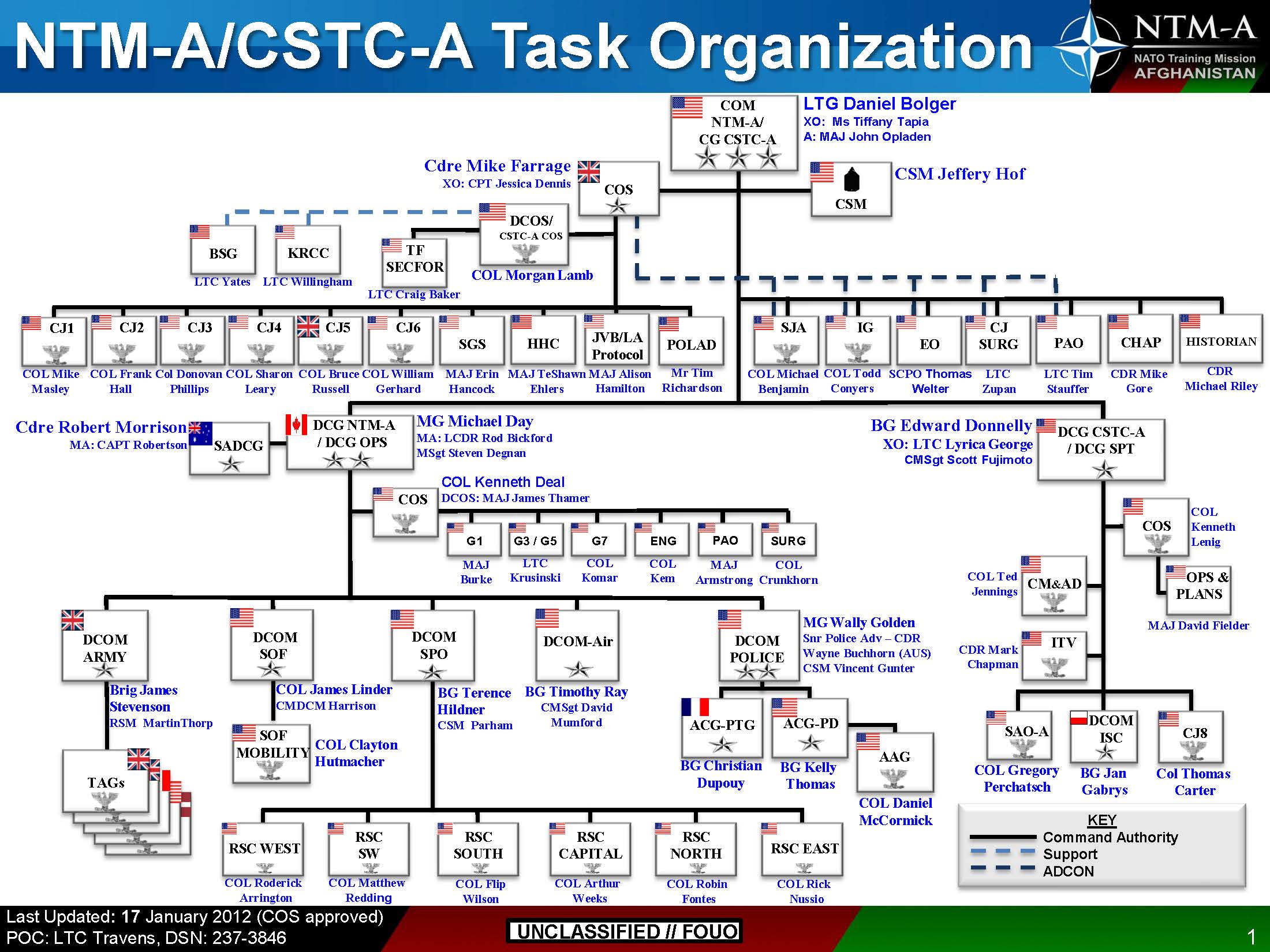
4. Example: NATO in Afghanistan
http://publicintelligence.net/wp-content/uploads/2012/02/NTM-A-OrgChart.jpg
NATO's mission according to the news
Wikipedia's NATO

Homework:
1. PLEASE PICK A NATO MISSION and fill it out in the Folder titled "NATO - Student Folder 2015" and then begin your research on your recent NATO mission (1992 to present day) that you picked today in class.
-You must have a basic outline on who is involved?
-How long have they been there?
-Why Peacekeepers or NATO troops are there?
-Where and what does the current situation look like?
-What challenges do Peacekeepers or NATO troops face?
-Here is a recent project I have done with students in the past and I am looking for a similar scale example from you all - NATO or Peacekeeping Mission Project